L’infinito
Movies


“What was the starting point for this project, with which you are making your directorial debut?”
A Wednesday as solemn as a traffic light, during an afternoon phone call with Paolo. At one point, after my initial whining about depression, Paolo, as if it were the most normal thing in the world, suddenly told me that "this time" I would direct a film that we would write together and that he would produce. With the unconsciousness of unconscious adult men, I accepted, and we agreed to make a free and intimate film. But a film about what? About you, since you'll also be the protagonist.
“And what did you think of?”
I thought of Emmanuele Carrère, whom I still need to figure out if I like him a lot or not at all, but I thought about how he often bases his stories on an incontestable biographical reality that influences the entire development of events, like a current. To be normal, altered, false, authentic. But I didn't have an idea of how I would do it. So, during the actor auditions, in the preparation phase, I "self-auditioned" and watched myself often after the recordings. I then decided that during filming, in agreement with Paolo, I would not watch myself after individual takes, but only once the scene was concluded.
“How did you approach your first set as a director?”
Perhaps with that childlike gaiety with which one goes on a school trip to visit caves and churches, leaving empty desks in classrooms. The paradox was that I had to direct and act in a film, but at the same time, I wanted to "visit" it, and perhaps the film is the result of this state of mind. From the first day of shooting, I saw that, like the words and thoughts shared with Daria D’Antonio and all my classmates, they became concrete; I could touch them. I know well that novices, if they are not besieged by the pain of not knowing how to do something, are enchanted by everything and say naive words, as in my case, but I really wanted a naive and childlike film, like the characters in my beloved "Sillabari" by Parise. I saw that Rome we had imagined and sought, icy and gray like certain Baltic cities and assailed by dark stairs like tunnels. The empty spaces seemed evacuated, like the feelings of that man in a coat. Even acting as myself found that wandering uncertainty of the punch-drunk boxers from Jarmusch's and Kaurismäki's early films that I had in mind, whose received punches had amputated their pride. Obviously, during filming, I continued to take other bad blows, but all from myself. The worst was one night of shooting when I found myself, as the script read, in front of a staircase, which I had chosen, which I was supposed to climb, I who hate stairs, I who had written that curse. Everything was ready; the torment was all well laid out for me, who had wanted it. I had described the protagonist as a man who hates stairs condemned to climb them, removing the fact that I would have to climb them, I who indeed hate stairs and love elevators. A self-inflicted torture on which a psychoanalyst could have built a penthouse, but to give myself strength, I thought that perhaps, to "strip" oneself as the film aspired to do, it was necessary to forget oneself.
“You mentioned some references that influenced you; can you tell us more about the film’s style?”
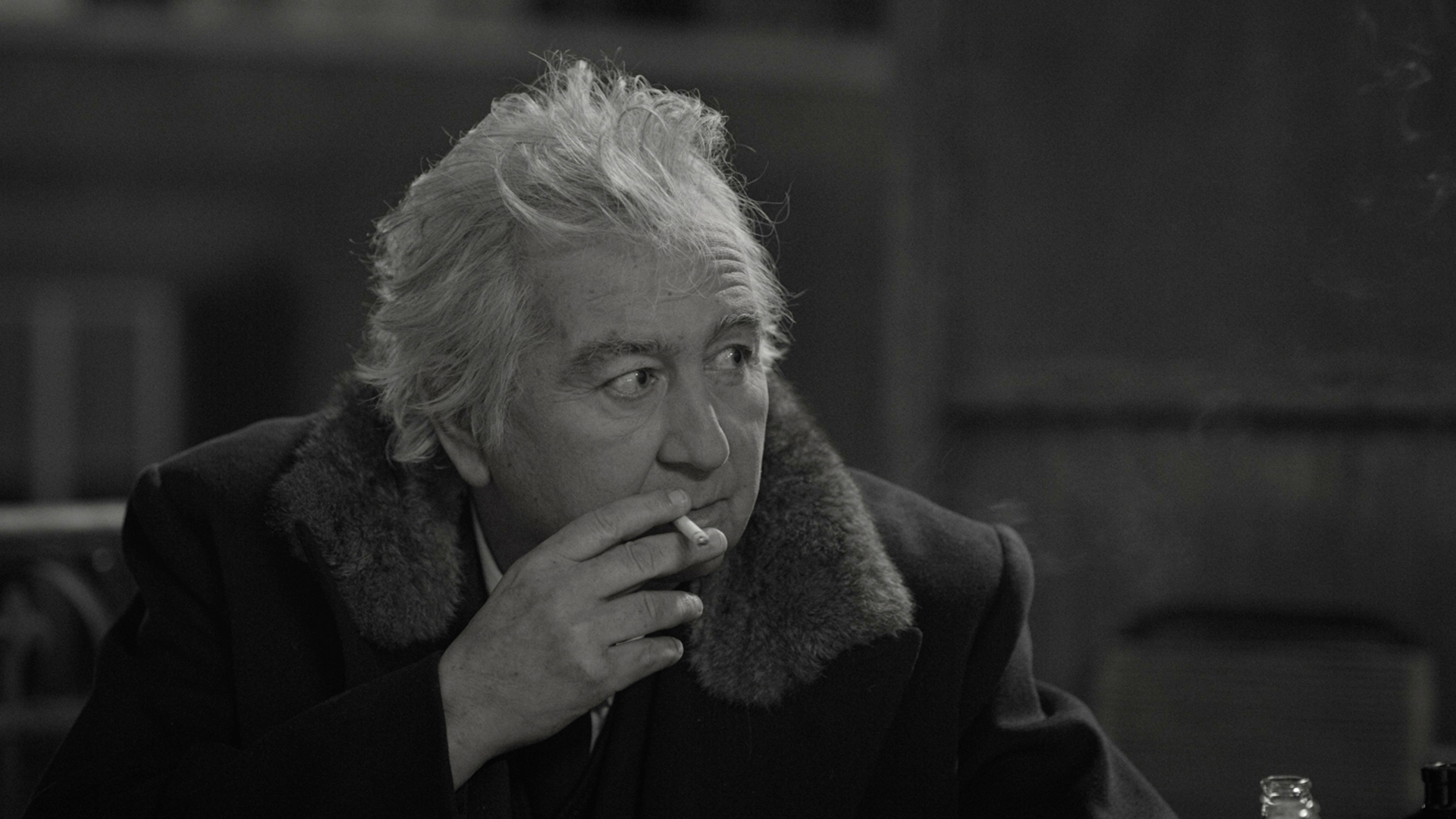
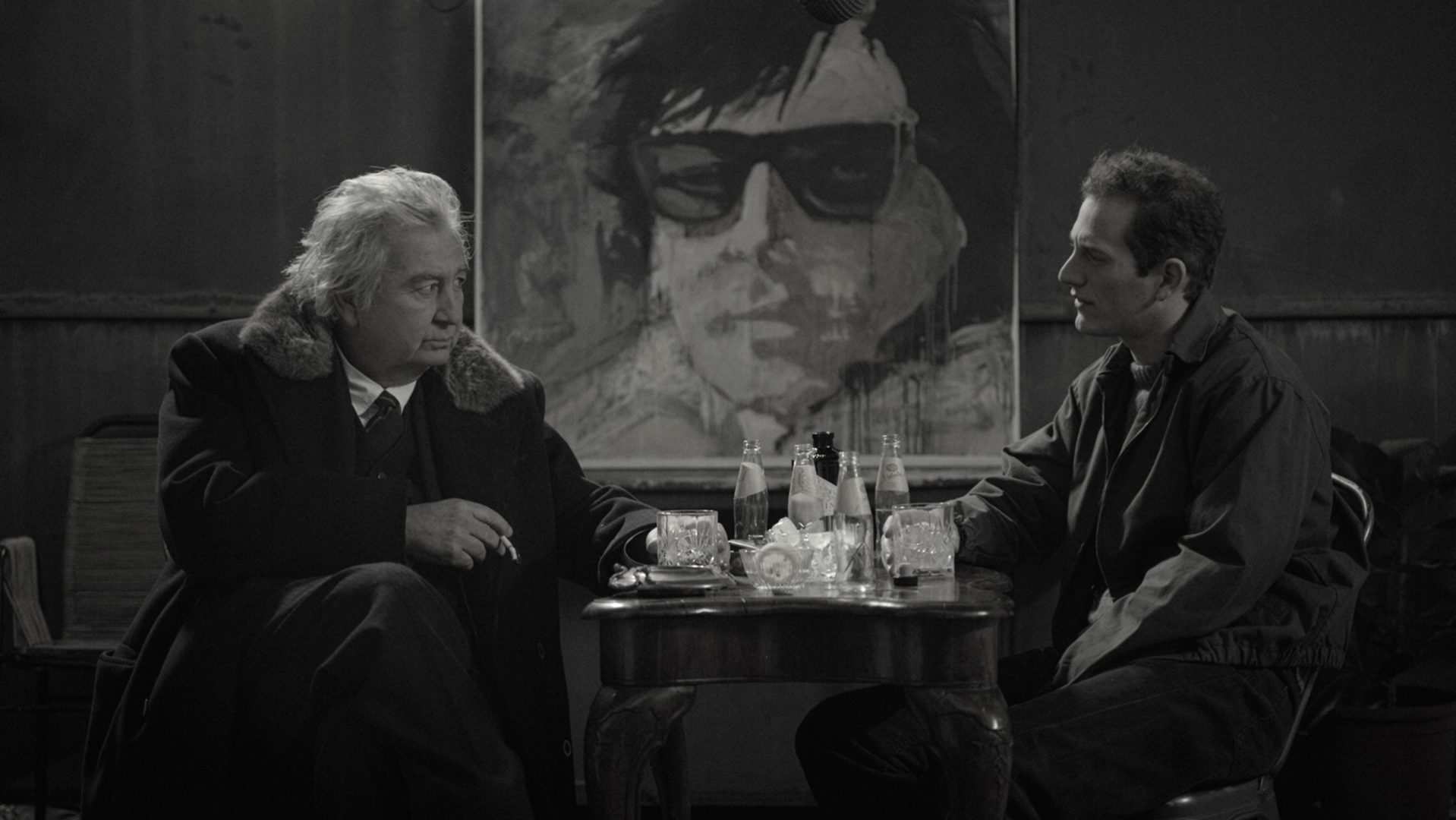
As a novice, I remember this so that these notes are acquired with a welcoming detachment; in my opinion, style is formed starting from the first major binding choices. I consider "constrained fantasy" the prerequisite for any well-done and ambitious work. In this case, I had three constraints that we enthusiastically imposed on ourselves. The first was the time available for shooting with a novice director and a perhaps slightly disproportionate script. The second, requested and obtained, was to shoot in black and white, or as we jokingly said, in gray, to remain connected to the style and mood of the writing; the third was to shoot rigidly without moving the camera. I distinctly remember Paolo indicating in capital letters on the script, at the top of a scene, the only very brief dolly shot I could use. He wrote, I believe, “IN THIS SCENE THE ONLY DOLLY SHOT OF THE ENTIRE FILM IS ALLOWED.” Here there is an interesting paradox: self-deciding constraints is already deciding a large part of the style. An obviousness, indeed, from a novice. These requested, not imposed, constraints established a good part of the style, that is, the way of telling a few days of this pitiful and perhaps even funny fellow.
The rest, besides the constraints, as Carver distinguishes in his very useful "On Writing," is composed of influences. The influences, the rational sources, let's call them that, listed at random, were various. Jarmusch's second film "Stranger Than Paradise": I wanted to take from that film the relationship with time, the "duration" of the scenes, the indelible feeling that it was a film that didn't want to escape from anything, but to dwell in its subtle lyrical and patient vein. Starting with the first scene, before the credits, which I had never forgotten, with that girl about whom we know nothing, who from the edge of an airport watches a plane land, immersed in gray. From Kaurismäki, the naivety and involuntary comedy of how he depicts the heaviness of his characters' lives dancing on the precipice of the world. In particular, their lack of astonishment in the face of the absurd things they stumble upon. Then I tried to understand Bill Murray's absent acting, an unattainable model. And then I carefully and obsessively studied the extraordinary character work Paul Newman did in Sidney Lumet's "The Verdict" because he managed to combine the loss of strength, fragility, decline, and perhaps even the loss of self-esteem, without ever demolishing an inner power – which perhaps dates back to the past or belongs to him as a structure of his character – in a way that the character is never decadent, never rhetorical, and always viewable from two sides. I studied Sidney Lumet's "Making Movies." Finally, there remained the influence, not the influx, that dominated my inner life: Goffredo Parise's "Sillabari" and his kind of "imprecision," which is the lyrical component of his "Sillabari." Unconsciously, looking back at it today, I was looking for a temporal imprecision, a kind of vagueness as if every scene should be a kind of "maybe this is how things are" and not an assertive "this is how they are." All novice things that I am forced to say because I serenely continue to be one.
“What kind of relationship was created on set with the actors and crew?”
The set of this film represented for me the last great vacation of my life; in many respects, that lightness and also what I felt as a boy when I moved with Carlo Mazzacurati and my young friends from Padua in a perfect condition, thoughtless and serious at the same time, reassured me. Like during the sequence that involved me and the nun on the scooter. An infinite joy, a Youth as Parise himself describes it in his "Sillabario."